Sunday, January 28, 2007

아름다운 지리산

I used to buy postcards as souvenir. The postcards that I have collected help me to recall those places that I have visited. However, these days, I depend much more on digital camera to capture images of memorable value that I have neglected visiting souvenir shops to check on the postcards. Perhaps I should try to make a stop at the souvenir shop again next time.

In Busan, many years ago, I bought a pack of postcards on Mt. Jirisan. I never heard of the mountain and neither did I know where the mountain was. I just bought the postcards because they looked nice. Today, as I was clearing my drawer, I came across the postcards again. Pictures of mountain always inspire me. The thought of visitng Mt Jirisan flashed through my mind in that moment. But for now, all I can do is just think.

The postcard pack has some note about Mt. Jirisan. Mt. Jirisan spreads over three provinces, namely, Jeollabuk-do, Jeollanam-do and Gyeongsangnam-do. It is known as one of the three legendary mountains (삼신산-三神山). The other two being Mt. Geumgangsan (금강산-金剛山) and Mt. Hallasan (한라산-漢拏山). With its highest peak, Cheonhwangbong, at 1915 metres above sea level, Mt. Jirisan is the second highest mountain in South Korea (The highest mountain is Mt. Hallasan at 1950 metres). It was designated as a National Park in 1967.

The name 'Jiri' (智異) is translated to be "Exquisite Wisdom", a Buddhist-based term used in the Diamond and Lotus Sutras to describe the extraordinary, refined and precious wisdom possessed by Munsu-bosal (Manjusri-the Bodhisattva of Wisdom) which can be used to enlighten all the universe's beings. Mt. Jirisan has long been associated with this Bodhisattva and there is a common belief that staying for a while in this mountain can transform foolish people into wisemen.

Mt. Jirisan marks the southern end of the mountain range 'Baekdudaegan' (백두대간-白頭大幹) which run longitudinally down the Korean peninsula. The northern end of 'Baekdudaegan' starts at Mt. Baekdu (백두산-白頭山) that spreads across the North Korea and China border. Mt Baekdu is known as Mt. Changbai (長白山) in China. With its challenging terrain, Baekdudaegan is fast becoming the next favourite long-distance trekking trail for adventurers who are seeking out new destination for their adventure.

Saturday, January 27, 2007

새 산과 들

I have finally discarded the familiar "old blogger" to embrace the "new blogger" a week ago. It is always not easy to get out of one's comfort zone to adopt something new. If its ain't broken why fix it? But I guess if I don't try to fix it, I won't know what is better out there.

After converting to the new blogger I have to spend some time to redo my blog template and learn about the new "drag and drop" layout. Fortunately, the learning curve is not very steep and I have since gotten used to the new blogger interface. The only gripe I have after converting is that those non-English names in the comment pages turn out garbled and there is nothing I can do about it.

With this change, I also make a new banner head from the picture I took in front of a pond at the base of Mt. Tohamsan in Gyeongju. I like the picture for its reflection, shadow, greenery and remnant of autumn hue.

For the coming weeks, I will probably have to reduce the rate of blogging. There is a lot of work to complete in anticipation of my 3 weeks break in March. I am not yet counting down to the time I leave for my short-term study. There is still so much things to do and of course blog to update at the same time. It will be busy but interesting weeks ahead.

Thursday, January 25, 2007

송년회

해가 바뀔 때 어디에 계셨습니까? 저는 상해 난경로에 있었습니다. 사람들이 얼마나 많는지 파도처럼 끝없이 제 앞에서 밀렸습니다. 송년의 기분을 강하게 느낄 수 있었습니다. 송년회가 10시부테 시작했지만 사람들은 송년회를 본 것에 의해서 시대광장에 일찍 오고 기다렸습니다. 사실은 혼잡한 곳을 별로 좋아하지 않습니다. 그런데 송년회를 보고 싶었는데 사람들과 같이 함깨 기다렸습니다. 송년회는 끝까지 봤는데 재미없었으니까 조금 실만했습니다. 제 새해 첮째날 그런 재미없게 보냈습니다.

Monday, January 22, 2007

에추! 에추!

Click on the picture to see the flash animation

The weather has been rather erratic recently. One moment it is raining non-stop. The next moment it is bright and sunny. It is so easy to catch a cold when there is drastic weather change. So everyone out there, please take care.

제 디지털 카메라

A night scene at "Waitan", Shanghai, taken with my digital compact camera

I have been thinking of switching to a digital SLR camera for quite sometime but have not done so yet primarily because of its bulkiness. Another reason is that I have no habit of taking pictures unless I am overseas. Buying a SLR and keeping it in the drawer would be a waste of money.

In term of picture quality and colour brilliance, my present compact digital camera has its limitation though I like its compactness. Because of its compactness, I can take picture with one hand, I can place it anywhere to take a picture and I can take picture anywhere without feeling awkward. It is not a high-end camera when compared to today's standard. It is only a 4-megapixels camera but "pretends" to be a 8-megapixels through some electronics iteration process. Furthermore, I think its video camera function fares better than its camera function. It is such a "weird" camera. I would not have bought it if not for the sweet talk of the salesman. However, as I become familiar with it, I discover that its night shoot ability is actually much better than many other compact cameras in its range.

In spite of all that are said, I am still thinking quite hard of getting a SLR for the coming Korean trip. I will like to capture the mountains and fields in their full grandness which I doubt my compact camera is able to do. Nonetheless, I will still bring it along because it has been working fine so far.

Sunday, January 21, 2007

경희대에 가자

On the road to the College of Fine Arts in Kyunghee University. It was still a few weeks to spring which started in April and the trees were still bare.


Yesterday I was back at NUS Extension to submit my registration form for the 3 weeks spring intensive Korean language course at Kyunghee University. Coincidentally, three of my former classmates were also there submitting their document for the same course. It is great to know that I am not going to be the lone Singaporean in Kyunghee.

My quest to go for the 10 weeks language course at Sogang University may not have materialised as wish but I have yet to give up. It will probably take a longer time to come. Meanwhile, a short term course at Kyunghee will suffice. Every opportunity is valuable to me especially when I have to put in sacrifices to make each happens.

In Shanghai, I bought a winter coat and some warm clothing. I have started my preparation to go back to school. My mind has seldom been rejuvenated since I started to work. The routine and mundane world has taken its toll on my mind and soul. I don't think I can be the best of myself with a tired mind and soul. I thought it is about time for me to pursue what excites me so that I know I am still living.

Eight years ago while walking in a small town of Jinhae, I knew I would learn the language one day. Maybe it has taken a long time for the thought to bear fruit but it is never too late. Three weeks may be gone in a wink but to know that I have waited long for these days, I will make the most out of my three weeks in Kyunghee. In a month time I shall be packing my bag. At the same time I will be unpacking my mind and soul. It's time to live.

Saturday, January 20, 2007

창덕궁에 대해서

Of all the Korean palaces that I have visited only Changdeokgung (창덕궁-昌德宮) made it compulsory for visitors to subscribe to guided tour. While I would have liked to wander freely in the palace I was stuck in a tour group. When the time came for my tour to start, a Korean guide greeted us, "Annyeong Hashimnida" and requested politely for us to repeat after her. I was thinking to myself why wasn't she saying "Annyeong Haseyo" like what I heard in the Korean movies. Of course, she was using the most polite form while I was expecting to hear a more common form of the greeting. I only know the difference after studying Korean langauge.

I found it very difficult to take pictures when I was in a tour group. I liked to listen to what the guide was saying. Taking pictures would distract my concentration and so during the tour of Changdeokgung, I rarely took out the digital camera which I bought specially for the trip. One interesting story which I heard was about the blue tiles. The guide told us that Korea was the first in the world to perfect the technique of making blue tiles. The blue tiles she spoke about, are exactly those that are found on the roof of Cheongwadae (office of the President of the Republic of Korea). The blue tile was once a sought-after item that the Japanese captured the Korean tile artisans back to Japan to produce the tiles for them. I never thought that such simple blue tiles could be both a source of Korean's pride and sadness.

Injeongjeon Hall (인정전-仁政殿), the main throne hall where all major activities in the palace took place.


The tour also brought us to the "Secret Garden" or Biwon (비원-秘園). Biwon was supposed to be a place where the royal family once spent their royal retreat. I was anticipating something exotic and beautiful, only to be let down later by what I saw. Biwon looked aged and run-down. The garden and pond were not well maintained. The place was gloomy and bleak though I thought Biwon was as authentic as possible. The place was already history afterall. It just could not be looking like it was just renovated recently or made to give the impression that people were still living in it. Perhaps, history is best left sleeping. But if tourist money counts more than history, Biwon might have to be restored to its former glory.

Changdeokgung was not big. It didn't take many hours before I was back at the main entrance again. I thanked the guide for showing us around and left by the main entrance. I tried to recollect what I did after I left Changdeokgung but could not. It seems that memory is only lasting when something is done, regardless of whether it is interesting or not. Perhaps, I should have just lived a live without doing anything so maybe there won't be any sweet or sad memories to unsettle my mind constantly. But that is just an unpractical thought. Give me another palace and I will still visit it.

Biwon was built in 1623 and was originally called the "Huwon" or the "back garden".

잊을 수 없는 곳에

Shanghai is divided by the Huangpu River (황포강-黄浦江) into Pudong (포동-浦東) and Puxi (포서-蒲西) just like the Han River (한강-漢江) that divides Seoul into Gangbuk (강북-江北) and Gangnam (강남-江南). While Pudong is meant to be the future of Shanghai, Puxi is the old and modern-day Shanghai. The old western buildings at the Bund or Waitan (外滩) at Puxi are magnificient to look at after dark, whether from a distance or close-up.

Friday, January 19, 2007

걸었던 곳에

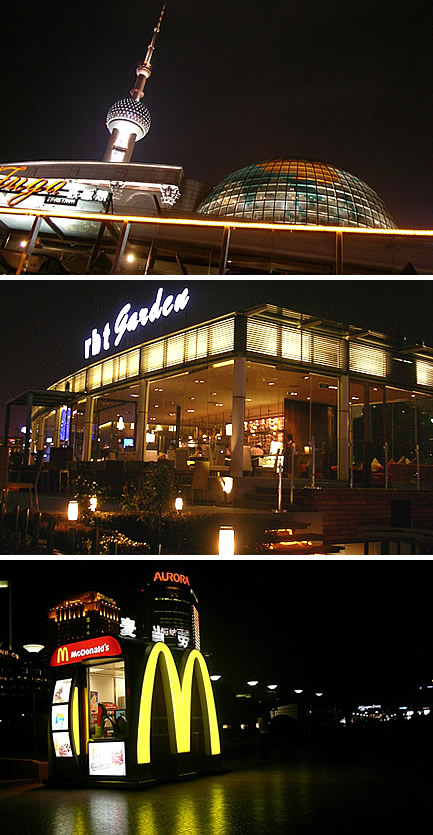
There was very little light at the Riverside Park in Pudong. The air was cold enough for me to keep my hands inside the pockets. It was a nice feeling sitting out by the riverside during a winter night. Darkness made lights more attractive. I could not keep my eyes off these dining outlets at the park. They look so outstanding in darkness.

[Top] Fuga Teppanyaki at Oriental Riverside Hotel. [Middle] rbt Garden western restaurant. [Bottom] The big M's drink and dessert kiosk.

Tuesday, January 16, 2007

강남이 좋은 곳입니다

In Korea, Gangnam (江南) refers to the region south of the Han River (漢江). The Gangnam district (江南區), in particular, is a place meant for the affluent Koreans. Property prices are sky-high. Streets are flanked by up-market boutiques, shops and department stores. Apgujeong (狎鷗亭) is one of the most fashionable shopping spot in the Gangnam district. Of course, it is a place meant for those with deep pocket. I don't have deep pocket, so that more or less explain why I have not been to Apgujeong despite visiting Seoul on three occasions.

As I look up the city map of Seoul, I sort of realise why Gangnam district is such a sought-after place for business and home. Gangnam district is situated at the bend of the Han River and in "fengshui" study, this is supposedly to be an area that accumulates a lot of good "qi" (energy). Gangnam district, indisputably has one of the best "fengshui" along the Han River. Because of that, people who set up their home or business in this district are expected to enjoy the prosperity that comes along with the good "fengshui".

In China, Gangnam is pronounced as Jiang Nan (江南) and it refers to the region south of Chang Jiang (长江) or Yangtze River (扬子江). Jiang Nan, as I know it, is a region that has beautiful scenery that captivated the imagination of the Chinese people since time immemorial. The scenery was so beautiful that Jiang Nan was once described as a heaven on earth. But I doubt the region is still as beautiful as was described, primarily because of the rapid development and pollution in the region.

I cannot visualise the beauty of Jiang Nan's scenery until I visited Yi He Yuan (颐和园) in Beijing. I was told by the guide that Emperor Qianlong (乾隆) of the Qing Dynasty, being a filial son, built a "mini" Jiang Nan in Yi He Yuan when he knew that his mother missed the scenery and life of Jiang Nan after visiting it. Just look at the picture below to understand the beauty of Jiang Nan. I am not too sure how to describe its beauty but I would probably be inspired to recite a few poems if I am a poet.