Some people commented that it is easier to find one's way in Japan rather than Korea because Japan uses Kanji which is essentially traditional Chinese characters. So even if they can't read Japanese, they can at least recognise the Kanji and guess the meaning. In Korea, the signs and displays are almost in Hangeul and if it happens that there is no English translation they will be lost.
However, I do not quite agree because I travelled in Korea four years ago without knowing a single word of Hangeul. I managed to buy the right train ticket from Seoul to Gyeongju and back despite telling the ticketing staff that I want to go to "Gwongju". If he had not verified with me, I would have probably landed in Gwangju. Despite that minor incident, I never thought that I was lost at any time. I found all the places I wanted to go with the help of maps and all the tourist information booths that I can find. I felt like I was at home in Korea.
Perhaps as a city-dweller for all my life, all the cities in any countries will generally appear the same to me. I also have the same feeling of at home in Shanghai. I found my way easily and I thought it was much easier to take a public bus in Shanghai than in Singapore. The routes of all buses are written clearly at the bus-stop and there is public address system inside the bus to inform me of the name of the next bus-stop. Better still, there is bus-conductor to collect fare. Of course, it also helps that I can read and speak Chinese.
During my stay in Shanghai, I took metro and public bus all the way to the suburb in search of Fudan University. I know Fudan University because of Chinese debate. There was this bi-annual Chinese debate competition between invited universities of the world which I used to follow closely. Fudan University was known to produce very fine Chinese debaters. So like a person on a pilgrimage, I came, found and saw Fudan University campus at East Wenshui Road. Walking in the campus under the leafless trees in a cold winter morning, I felt a strong urge to go back to university. I really hope it will happen soon.

[Left] Guanghua Building (光华楼), the landmark of Fudan University. [Right] The emblem of Fudan University which can be found, at regular interval, on the fence around the campus perimeter.


 In Korea, Gangnam (江南) refers to the region south of the Han River (漢江). The Gangnam district (江南區), in particular, is a place meant for the affluent Koreans. Property prices are sky-high. Streets are flanked by up-market boutiques, shops and department stores. Apgujeong (狎鷗亭) is one of the most fashionable shopping spot in the Gangnam district. Of course, it is a place meant for those with deep pocket. I don't have deep pocket, so that more or less explain why I have not been to Apgujeong despite visiting Seoul on three occasions.
 This bell has been sitting at my study table since I bought it in a souvenir shop in Busan eight years ago. It is a miniature replica of the "Divine Bell of King Seongdeok" (성덕대왕 신종, 聖德大王神鍾). According to record, the bell was made by the 35th King Gyeongdeok of the Shilla Kingdom to pray for the soul of his father, King Seongdeok.

 As a result, Kim Dae Jung was awarded the Nobel Peace Prize in 2000.
 [Left] Guanghua Building (光华楼), the landmark of Fudan University. [Right] The emblem of Fudan University which can be found, at regular interval, on the fence around the campus perimeter.
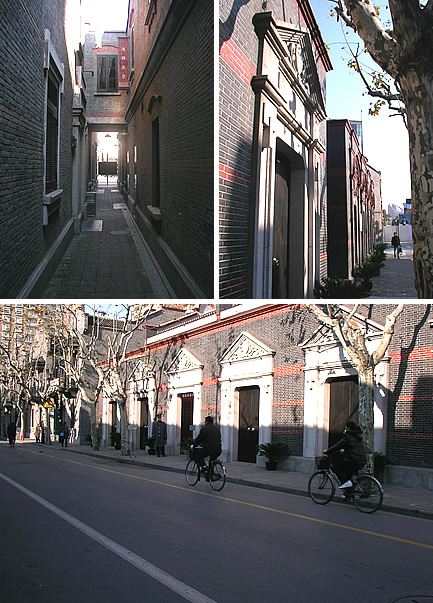 Xintiandi (新天地-신천지) looks bleak in contrast with the colourful Nanjing Road. But both share a similarity - they are both commercialised. While Xintiandi still delivers a piece of the old Shanghai charm, it has since been remade into a food, drink and entertainment destination. Time wastes away history but commercialism preserves history - but only the facade. The soul has long gone.