
Today is Mid-Autumn Festival (中秋节) and it is a working day in Singapore. In Korea, it is called Chuseok (추석-秋夕) and they have three days of holiday in a row - one day for the Koreans to make their journey back home; one day to celebrate Chuseok and one day to return to their place of stay. In China, I heard, they have a week of holiday when it comes to 'Zhong Qiu Jie' celebration.
In Singapore, Mid-Autumn Festival is about family reunion, eating of mooncake and pomelo and lantern parade. The festivity mood has been rather low probably because there is no autumn here in the first place and there is no public holiday for festival celebration. However, in the last few years, things are getting slightly better. There are more lantern parades organised. Chinatown was dressed and lighted up for the festival. A lot of creativity was also given to the making and packaging of mooncakes. Besides the standard lotus-bean paste mooncake, there are also novelty mooncakes like chocolate, ice cream and durian mooncakes.
To me, the festival always remind me that while people may be separated by distance on this Earth, we will always be looking upon the same moon.
 |
In Singapore, Mid-Autumn Festival is about family reunion, eating of mooncake and pomelo and lantern parade. The festivity mood has been rather low probably because there is no autumn here in the first place and there is no public holiday for festival celebration. However, in the last few years, things are getting slightly better. There are more lantern parades organised. Chinatown was dressed and lighted up for the festival. A lot of creativity was also given to the making and packaging of mooncakes. Besides the standard lotus-bean paste mooncake, there are also novelty mooncakes like chocolate, ice cream and durian mooncakes.
To me, the festival always remind me that while people may be separated by distance on this Earth, we will always be looking upon the same moon.

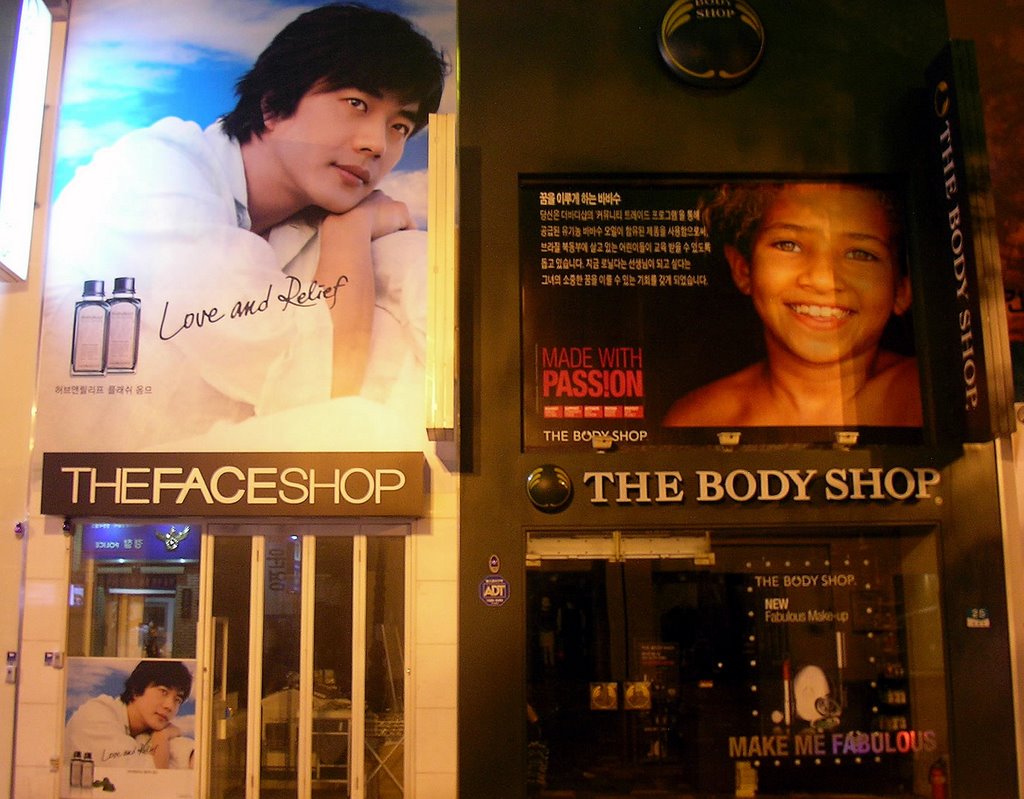
 When the ending consonant of the preceding word is 'ㅇ', the consonant 'ㄹ' in the current word will have to change to 'ㄴ' pronounciation. Hence, it was correct that '청량리' was pronounced '청냥니' and there was nothing wrong with my hearing. Because of Cheongnyanni, I was able to memorise this special deviation and I now pronounce '정리' (arrangement) as '정니' and '등록' (registration) as '등녹'.


 이 게 뭐에요? 빨리 대답해요.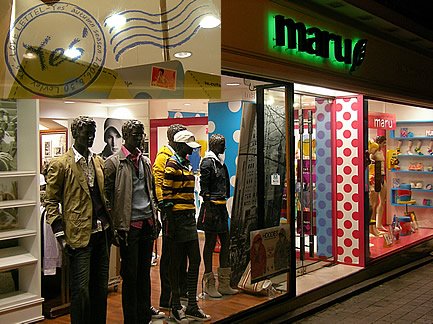
 The subway from Myeongdong Station to Suwon Station took about 45mins to an hour and cost 1,400won. On arriving at Suwon Station, I was greeted by a shopping mall that housed both the rail and subway station. On exiting from the shopping mall, I found my way to the tourist information counter, a short walk from the station. The lady at the counter introduced Hwaseong Fortress(화성-華城) to me in flawless Chinese partly because she studied in Tianjin before.
 Hwaseong Haenggung was in fact only a small part of the Hwaseong Fortress. The fortress was so big that I just did not have the energy or time to walk one round of its perimeter. There was supposed to be this Hwaseong Trolley(화성열차-華城列車) with a cospicuous dragon head that drove tourists around the fortress for 1,500won. If I had just gotten onto one of it, it would have saved me a lot of walking. 다리가 정말 아파죽겠어요.
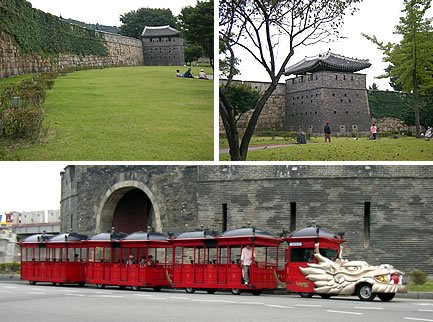 When I left Suwon for Seoul, I did not manage to see any "water plain". I was kinda of disappointed but I thought if I could have a few more days at Suwon, I might discover some interesting water features that befit the name Suwon. Well, whatever the thought may be, it will have to be next time.