Monday, April 21, 2008

외도에 갑시다

To get to Oedo (외도, 外島) from Busan, I would first need to get to Jangseungpo, (장승포, 長承浦) at Geojedo (거제도, 巨濟島). I left my hotel at 9am and it took me about 15 minutes of walking to reach the Busan Coastal Ferry Terminal (부산항연안여객터미널, 釜山港沿岸旅客客运站). Over at the terminal, I bought a one-way ferry ticket to Jangseungpo at 19,200won. The ferry departure time was at 10am. 10 minutes before departure, boarding of ferry commenced. Seat was pre-allocated but since the ferry was quite empty that morning, I just looked for a nice comfortable spot, away from the sunlight, and sat down. The wind was blowing strongly and the sea was slightly heavy. The ferry rolled quite a bit. Since I am not a person who will get seasick easily, the rough sea didn't really bother me. Soon after the ferry departed, I fell asleep. The rolling of the ferry was very good sleep-inducer.

The Busan Coastal Ferry Terminal where I took my ferry to Jangseungpo.

I boarded this high-speed ferry, Democracy 1.

Passengers disembarking from ferry that just arrived at Busan terminal.

Ferry sailing under the Busan Bridge (부산대교, 釜山大橋).

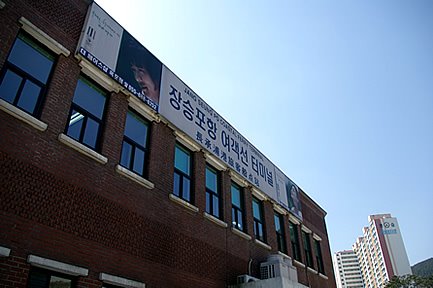
After about an hour out at sea, the ferry finally arrived at the Jangseungpo Coastal Ferry Terminal (장승포항여객선터미널, 長承浦港旅客船客运站). I got off the ferry and dropped by the tourist information counter located in the terminal building. I paid 17,000won for a tour package to Oedo. They issued me a receipt and instructed me to walk over to the Jangseungpo Cruise Ferry Terminal (장승포유람선터미널, 長承浦遊覽船客运站), about 300 metres away, to exchange for the tour ticket.

Democracy 1 berthed alongside Jangseungpo terminal at Geojedo.

The Jangseungpo Coastal Ferry Terminal building in Geojedo.

While changing for my ticket at the Jangseungpo Cruise Ferry Terminal, the counter staff gave me a map and briefed me on the tour itinerary in a mixture of Korean and English. The briefing went something like this: The ferry will first sail to Haegeumgang (해금강, 海金剛) Island and that will take about 35 minutes. After that, the ferry will take you to Oedo and you will have one and a half hours to tour the island before the ferry brings you back to Jangseungpo. The whole trip takes about 3 hours.

To ensure that I don't miss my ferry at Oedo, the staff wrote me a note to give to the tour guide: 선장님! 외국분입니다. 돌아오는 시간 알려주세요!! (I am a foreigner. Please tell me the time of return.) I didn't use the note though, since I understood the more important instructions given by the tour guide. The departure time for the ferry to Oedo was 12 noon. I waited for about half an hour at the ferry point before boarding commenced. At the waiting area, a group of Koreans gathered and were happily eating and drinking away.

It seems like Koreans can be quite casual about the place they eat. Straight after we boarded the ferry, another group of Koreans, seated right at the back, laid out their food on the deck and started feasting. As they were quite mindful about not inconveniencing others, nobody seemed to mind their activity. I thought I would be happy to join them if I was invited. It always give me a feeling of warmth to see people gathering to enjoy a simple meal. Such dining experience is unlikely to happen in Singapore though.

The Jangseungpo Cruise Ferry Terminal. It looks more like a ferry point.

A group of Koreans happily eating and drinking away in front of me.

Sitting inside the ferry, it suddenly became clearer to me what this term "work restructuring" actually meant. When there is no "work restructuring", a ferry would probably need only one helmsman to drive it. But when work is "restructured", the company can afford to employ two helmsmen for one ferry. In this ferry that I was in, one helmsman doubled up as a tour guide while the other peddled dried cuttlefish to the passengers. Whenever there was something to talk about along the journey, the tour guide would hand over the helms to the other guy. After he had completed his talk, he would take back the helms so that the other guy could go around selling dried cuttlefish. The lesson here is that one should not be satisfied just being a helmsman because that is not going to bring in more pay and worse, the job may be lost when business becomes non-profitable. I was kinda inspired by how the ajeosshis went about doing their business.

Now come the interesting part - the dried cuttlefish (마른 오징어). The tour guide said that their dried cuttlefish is fresh and very very tender (싱싱하고 말랑말랑해요). It sounded contradicting but I got the drift. The dried cuttlefish was selling like... well... dried cuttlefish. One bag packed full with dried cuttlefish was emptied within minutes. People were buying like two three sheets each and some bought a whole stack. A ajumma who sat beside me bought two sheets. After receiving her cuttlefish, she tore them into strips quickly. As she was tearing, she put a strip into her mouth and started chewing. Then she turned to me and offered me a big strip as well. In no time, the whole ferry smell like dried cuttlefish. For people who like cuttlefish, it was heaven.

Ajeosshi selling dried cuttlefish to passenger.

Korean oldies were played inside the ferry since their passengers were mainly ajeosshis and ajummas. About 35 minutes into the trip, we were told to go out to the open deck. Apparently, we had arrived at Haegeumgang and the tour guide wanted us to get a good view of the breathtaking rock structures. Haegeumgang means the "Mt. Geumgang of the Sea". The actual Mt. Geumgang is a famous mountain in the North Korea and a popular tourist destination. The ferry drove us into a narrow waterway in between two majestic cliffs. The cliffs were so high that they almost blocked out all the sunlight. We were all caught in awe by the grandeur of the sight that was presented in front of us. For a short moment, I realised my insignificance in this world.

I believed we were only given a few minutes of time before the boat started reversing out of the waterway. The next destination is Oedo. I shall write about Oedo in my next post.

Looking up in between two cliffs of Haegeumgang.

Haegeumgang or the Mt Geumgang of the Sea. Breathtaking rock structures

Sunday, April 20, 2008

성시경을 찾는 일

There are many reasons why people like about Korea and he is one of those reasons. Aini has reminded me to say hello to her Oppa, Sung Si Kyung, but all this while I have never caught sight of him in Seoul. Then, one day this April, I was standing in Myeongdong Station and there he was, with his melancholic look, asking passer-bys, can our story be continued? I can imagine that the Singapore's number one fan will say, "Oppa! Yesss..... it will continue forever and ever and ever and ever.....!" So Aini, here is proof of me saying hello to your Oppa. ^^


Friday, April 18, 2008

벚꽃

From a point of deprivation to a point of over-saturation, all within a span of a few days. Cherry Blossoms were all over the places in Busan. They are awesomely beautiful at first sight but soon, I found myself walking under them without givng them a second look. Perhaps, it's just the way the body physiology works. To much of the same stimulus and it will automatically cut off the excess to save the senses from overwork. The Cherry Blossoms should have withered by now. These pictures are the remaining memory of this Spring.


Wednesday, April 16, 2008

봄행

The day I left Seoul for Busan, I arrived at Seoul Station at about noon. I bought a KTX ticket for 47,900won (S$68) and rode the next train to Busan. The journey took exactly 3 hours. Everything seemed so easy and swift but yet it took me a long time, since my last visit, to finally return to Busan.

Busan Station. Doesn't look very different from Seoul Station.

My hotel wasn't far from Busan Station. Actually, it was only two subway stations away, near to Nampodong (남포동, 南浦洞). Nampodong is Busan's equivalent of Seoul's Myeongdong, though not as happening. Since I was feeling a bit nostalgic, I decided that I should take the subway. The cheapest subway fare in Busan is 1,100won and that is 100won more expensive than Seoul. There is also no manned ticket counter in Busan so ticket purchase has to be made through the ticketing machines. Another thing special about Busan subway is that announcements are made in Korean, English, Mandarin and Japanese. That's four languages compared to Seoul which uses only Korean and English. As I was coming out of Nampodong Station, the air was filled with fishy smell that probably originated from the nearby Jalgachi Market. In that instance, I felt a sense of closeness to the sea and indeed I was very close.

After checking in, it was almost evening time and I just had enough time to roam the streets of Nampodong. Places which I covered include the Gwangbongno (광복로, 光復路) Fashion Street, PIFF Plaza and Jalgachi Market. My dinner that evening was Krispy Kreme donuts. I heard a lot about this brand of donuts but have never tried them in Seoul as there was always long queue. I don't believe in queuing and alternative like Dunkin' Donuts is equally fine with me. The Krispy Kreme branch at Nampodong was not crowded, so I thought I should give it a try. Guess what? Before I even made my order, I was given one free original glazed donut. I was not the only one who got free donut, in fact the staff was distributing free donuts to every customers. I ate my free donut and it was so soft that it almost melt in my mouth. Next, I bought three donuts and I got another free original glazed donut. So all in all, I ate five donuts that night. Krispy Kreme has definitely left me with a very good first impression.

Fashion boutiques at Gwangbongno Fashion Street.


I love free Krispy Kreme original glazed donuts.


PIFF means Pusan International Film Festival. The film festival is usually held in October. Without the film festival, the PIFF plaza is just another walking street with shops, stalls and eateries. There are also quite a number of cinemas.


Two Chinese movies. 포비든킹덤 is a translation of its English title "Forbidden Kingdom". 삼국지 is a translation of its Chinese title "三国志". Korean is complicated, isn't it? By the way, Jackie Chan is called Seongyong (성용) here, a direct translation of his Chinese name 成龍.


Fishery port behind the Jalgachi Market. Fishing vessels are berthed alongside with the Busan Bridge as the backdrop. Though you may not be able to see it, seagulls were flying over the water surface.


A stainless steel sculpture of sea creatures seen outside Jalgachi Market.

Monday, April 14, 2008

거의 비슷해

On my flight to Korea, a Korean lady sat beside me. At some point during the flight, she started talking. I turned my head towards her, thinking that she might be talking to me but she wasn't looking at me. It seemed like she was trying to find something in her handbag. By then, it was quite obvious to me that she was talking to herself. For the rest of the flight, she talked to herself several times. I wasn't surprise since I heard from Kaye many times that Koreans like to talk to themselves. Like many Singaporeans, she finds it strange but not me.

Frankly, I used to have the habit of talking to myself. It never occurred to me that it was a strange thing to do, at least not until my disturbed friend kept reminding me that I was behaving rather abnormally. As a matter of fact, I didn't talk to myself randomly and neither did I behave as if I had suffered a mental breakdown or sort. I talked to myself only when I was about to do or was engaged in doing something. In my mind, I was quite clear that I wanted to talk about my intention and action to signal to others around me, including strangers, that as a person, I meant no harm to anyone. I knew that it was unsolicited but somehow I felt compelled to speak my mind at a volume that was loud enough to be heard. I believe that you can let your guard down in front of a chatty person or a person who speaks his or her mind freely. People who have no fear of saying anything and everything are rarely sinister. Similarly, one should not be worried when someone talks to himself or herself. It could well be some sort of social signal to say that I am harmless and you need not guard against me. But say what I want, it still remains a socially unacceptable behaviour, at least in Singapore. I have since kicked the habit to conform and be "normal" again.

Two lessons ago, my Korean teacher spoke about her habit of sleeping on the floor. It was something like she will let her son sleeps on the bed while she sleeps on the floor. It is not that she has to but she likes it very much to sleep on the floor. She reasoned that as 습관 (習慣) or habit. Her habit was developed since young in Korea when she used to sleep on the floor. In an ondol room, the floor is heated up by embedded heating elements. To keep warm, Koreans will sleep on mattresses lay out on the floor. There is a good reason why Koreans do not sleep on bed. The mattress on the bed is lifted above the ground and so there is a layer of air between them. Since air is a bad conductor of heat, it is difficult to warm up the mattress on the bed and one can still feel cold despite sleeping in an ondol room.

When I heard about her habit, I was like, hey, don't I have that habit as well? I like sleeping on the floor. It wasn't too long ago before I switched to bed. My old house used to have teak parquet flooring. So it was never too cold or too warm to sleep on the floor. For a very long time, I enjoyed sleeping on the floor with just a mattress, not that there is no bed but for some unknown reason, I tend to like sleeping on the floor more. Even now, though I am sleeping on a bed, I still find sleeping on the floor much more comforting. The reason why I stop is because the flooring in my room these days are simply too cold for the good of my body. I risk suffering from bad body aches if I am to do that. Nevertheless, given the right condition, I will still prefer to sleep on floor.

In another incident at the Seoul Station, I was buying my KTX ticket to Busan at the tourist information counter when the ticketing staff got kinda curious about my nationality.

Staff: Where are you from?
Me: Singapore.
Staff: Have you been a Korean previously?
Me: No
Staff: Have you ever hold a Korean passport before?
Me: No
Staff: Are you a Kyobo?
Me: No
Staff: You look almost like a Korean. There is no way I can tell you apart.
Me: ... (don't know what to say)

I tried to verify what the staff told me with 3 Malaysian tourists at Oedo (I will write about my Oedo trip later). I recognised them as Malaysians because of their accented Mandarin. One of them approached me to take a photo for them. Apparently, she assessed that I didn't look like someone who could understand English. So she just gestured to me to take a picture for them. Since I thought she had mistaken me as a Korean, I played along. Instead of saying one, two, three, I said 하나, 둘, 셋. After I took their picture I blurted out 좋아요 (that's good). I didn't think they sensed anything amiss. Okay, so much for the cheap thrill. Anyway, there are in fact many more encounters where the Koreans just left me alone without probing into my nationality. I suspected that they weren't aware that I am not one of them in the first place. But I like it that way, not that I like to be thought as a Korean but rather I don't fancy unnecessary attention.

Sometimes, it surprises me that I am in fact very similar to Koreans down to the core. My teacher said that Koreans don't like being praised and they will deny anything good you say about them. Even if it is true that they are hardworking and are doing very well, they will still deny it. To some, this seems hypocritical but to the Koreans, it is more important to stay humble. My friend used to tell me that I am almost humble to the extent of being hypocritical. I understood his point of view so I just kept quiet. But I am very clear that I am only as good as as my last achievement and there is always room for improvement. From my perspective, I am not being a hypocrite when I say that I am not good or I am not working hard enough because my belief is that there is no upper limit to improvement. I need to stay level-headed in order to continue to improve. I appreciate people who think that I am good but I would rather that they keep this thought in their heart. Frankly, I don't like to hear praises because it put me in an awkward position. If I acknowledge the praises, I am not humble, but if I don't, I am either proud or rude and to deny it, I am a hypocrite. Whichever way, I am still worse off. While I dislike praise, I am all for encouragement. 파이팅 is music to my ears. There are many more things to be accomplished in life so I need plenty of them.

With so much said, there is probably one incident that is in total disagreement. I was supposed to meet up with a friend in Busan for lunch. She smsed me that her friend and she are going to have "hwae" (sashimi) for lunch and asked if I would like to join them. I replied that I don't take raw meat and asked them to go ahead without me. Her following reply pretty summed up everything. She wrote, !!Haha totally missing out... Okok well enjoy your day then :). Just to reiterate, the key words here are "totally missing out" and I am in total agreement with what she said. I know quite well that not being able to eat "hwae" is like missing out a large chunk of the Korean's culture. In this programme, 6시내고향, which I like to watch on the KBS World, their reporters frequently sailed out to sea with the fishermen to report about their lives and harvest. Normally after every catch, the fisherman will cut, clean and slice up the fish, squid or octopus on the spot to make hwae. After that, everyone will be seen picking up the slices, dipping them in gochujang and eating them fresh. It usually ends with thumbs-up and everyone saying 최고, 최고 (the best). As much as I want to experience the 최고 taste, I can never bring myself to swallow any raw meat. So if it is about eating hwae, I have to concede, unless of course someone is kind enough to provide me with a griller ^^;;

Sunday, April 13, 2008

광안대교

Gwangan Bridge viewed from the promenade at Suyeong. The bridge lighting changes colour from time to time. The huge orange-coloured structures are the breakwater and they are supposed to be strong enough to withstand typhoon hit.

This is the Gwangan Bridge (광안대교, 廣安大橋) of Busan. Currently the longest bridge in Korea, measuring 7.4km in length. It spans across the Bay of Suyeong (수영, 水營) and connects Suyeong to Haeundae (해운대, 海雲臺). Watching the bridge by the beach has been my favourite evening past-time in Busan. Plus the sound of waves and the cooling breezes, it was simply delightful :)

Saturday, April 12, 2008

영어마을

The English Village is within walking distance from the Hyeri Art Valley. It wouldn't have make sense if I did not make it a part of my itinerary in Paju. When I first heard about the EV, I was like asking why would anyone build a full-scale English town for the sake of learning English. But the fact that it exists, shows that English language education is indeed a huge and lucrative business in Korea. It is no myth that an English teacher, teaching in a language school in Korea, earns much more than many company employees walking in the street of Seoul. But there is catch. The Korean Immigration will only issue the E2 work visa (solely for the purpose of teaching English) to passport holders of the following 6 countries: Australia, Canada, New Zealand, South Africa, UK & Ireland and USA.

Paju's English Village

Back to EV before I get too carried away. This is how I would describe the EV after my visit: It is a fully-equipped English language school cum a theme park. Since it is a theme park, I need to buy myself an entrance ticket which cost 6,000won. The ticket came with a EV passport and a guide. The guide is written in Korean but the ticketing staff was kind enough to point out those events which I could participate for free and their start-time and venue. After that, I was instructed to show the EV passport to the officer at the "immigration checkpoint" and have a simple English conversation with him. It was a simple dialogue alright. The officer only asked "where are you from?" and "why do you come to English Village?". Piece of cake, of course. After that, he stamped on the passport and off I went to the main gate of the EV which looks like a castle gate. By the way, the opening hours for EV are between 9:30 and 22:00 and it is closed on Monday.

At the main entrance of EV which looks quite like a theme park

Immediately after entering the main gate, I was greeted by the Market Street. Residing on both sides of this street are bakery, bookstore, cafe, eatery, restaurant, gift shop, museum and convenience store. Visitors are required to use English in these facilities and they are real and not mock-ups. Through the public address system, visitors were reminded repeatedly that only English is allowed to be spoken in the EV and speaking in Korean is prohibited. English language programmes which are available in the EV were also broadcasted from time to time. When there is no announcement, English children songs and stories were played through the system. Perhaps this is what is called "immersion".

I was actually going downhill as I walked along the Market Street . There was tram rail on the street but I guess it was there merely for aesthetic purpose since I didn't see any tram or trolley moving about in the village. It wasn't too long before I arrived at the central of EV where the grand City Hall building is seated. Beside sightseeing, there were outdoor activities for the kids like line-dancing and word game. EV Kids characters would also be around at the central area for photo taking.
 
Bakery Sobriquet - one of the many shops along Market Street

Double Decker Pub - an English Pub History museum

An English tram

The grand City Hall building seated right at the end of the Main Street

The City Hall building fronted by a water fountain

This is Hippokey. Now you know why I describe EV as a theme park.

This is Teero, a lion cub, entertaining the kids along the Main Street

A EV dance instructor teaching the kids and their parents line dancing

Other freebie that came with the ticket was a 30 mins long musical play at the Concert Hall. Watching the performance was the last activity I did in the EV. Frankly, I didn't find it entertaining but then again the play is meant for the kids. Though it was an English play, the performers were apparently quite in tune with the Korean pop culture. Things like Wonder Girls and their signature dance moves in "Tell Me" came out during the play to keep the audience amused.

The Concert Hall where musical plays are staged


Children playing at the fountain in front of the Concert Hall

A view that looks out to Hyeri Art Valley from the Concert Hall

A view of the Artis Avenue which ends at the Concert Hall


A view of the Oxford Avenue

The Outdoor Theatre, a nice place for family picnic

Dormitory for students on short-term English language programme

The UNICEF building, the last building at the exit of EV

The English Village is actually much bigger than what I can show here. There are many more buildings in the EV which my photos do not show. Without entering any of the buildings, it took me about an hour plus to cover most part of the village. All in all, I spent about 2 hours at the place but there are probably many more things which I do not get to see. Then again, I probably need not to, since the kids are the EV's targeted audience. I left EV feeling in awe, not so much by the size of the place or the buildings but by the fact that a place like this was even built in the first place. But it is incredibly true in Korea and I guess you have to see it to believe it.

A view of the Market Street just after entering the EV

Wednesday, April 09, 2008

딸기되게 좋아

I was asked to give more details on how to go to the Dalki Theme Park situated in Hyeri Art Valley. So here are the details as requested.

To get to Hyeri Art Valley, first make your way on a subway to Daehwa Station (대화역, 大化驛), the last station at the northern end of Line 3 (orange-coloured line). Once you arrive at Daehwa Station, look for Exit no. 5 and make your way out of the station. Upon exit, turn around and look for a bus stop beside the main road. To be sure that you get the right bus stop, stand facing the main road. To your left, there will be "Buy the Way" convenience store and to your right, will be Dunkin' Donuts. Turn your head slightly to the right and you should see a stadium at the far end. The stadium will be a good reference point on your return trip to Daehwa Station. There is an electronics bus information LED display board inside the bus stop. You can look at the board to know how long more it takes for the Bus no. 200 to arrive. From my experience, there will be one Bus no. 200 every half an hour.

The bus fare for Bus no. 200 is 1,600won regardless of the distance travelled. If you have T-money, then you need not bother about how much to pay. Once you get inside the bus, you can take a look at the bus-route charts that are put up throughout the bus. Apparently, the Hyeri Art Valley stop is not around when the charts were printed. So you will likely see the Hyeri stop being handwritten onto the charts. The Hyeri stop is the last sixth or seventh stop (I can't remember clearly) in the route. The bus journey from Daehwa Station to Hyeri takes about 50 minutes. The bus will move through the town from stop to stop before it hit an expressway. After a short journey on the expressway, it will exit and arrive at another town. When the bus enters the town, you should see a gigantic "English Village" sign, something quite similar to the "Hollywood" sign, at the far end. At this juncture, it will probably take another 10 to 15 minutes before the bus arrives at the Hyeri stop.

When you see the "English Village" sign for a second time, Hyeri Art Valley is just around the corner literally. I can't remember how many stops to go before I reached Hyeri but it won't be that many. The name of the stop will be broadcasted in Korean. If you understand Korean, just listen out for "헤이리 예술마을" (Hyeri Yesul-Maeul) and press the bell. The bus stop for the Hyeri Art Valley is located just outside of Gate 4. By the way, there is no gate at Gate 4, so don't try looking for one. To know where is Gate 4 and how to get to the Dalki Theme Park, refer to this map. Looking at the map, follow the red line to the Dalki Theme Park ticket booth.

To return to Daehwa Station, from the bus stop where you alighted earlier, cross the road and look for the bus stop across the road. There is a convenience store beside the bus stop. Take Bus no. 200 for the return route to Daehwa Station. Listen out for "대화역" and alight accordingly. If you can't understand Korean, keep a lookout for the stadium, which I mentioned earlier, and hit the bell once the bus comes close to it. After you alight, cross the road to get back to Daehwa Station. As a guide, travel time between central Seoul and Hyeri Art Valley is about 2 hours and this include waiting time for the train and bus. So all together, it takes about four hours for a return trip.