Sunday, October 08, 2006

제2회 한국어 말아기 대회

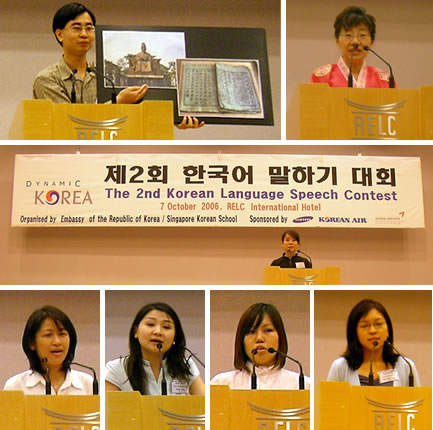
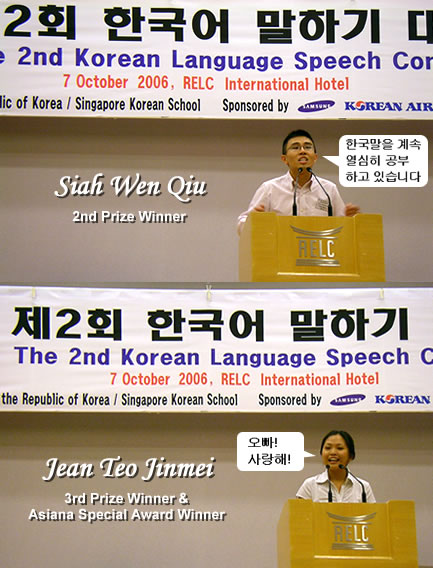
In the 2nd Korean Language Speech Contest held at RELC International Hotel auditorium yesterday, NUS Extension students won three out of the six prizes. Siah Wen Qiu won the second prize (there are two second prizes) for his topic on "의미 있는 만남과 한국어 공부". Jean Teo and Wong Er-Kai both won the third prize (there are three third prizes). Their topics were "일본에서 만난 한국" and "한국어를 공부하기 전과 후의 다른 점" respectively. Jean was also a receiver of a surprise award from Asiana Airline. Because of her touching presentation, Asiana decided to give her a free air ticket to Korea to meet her '오빠'. I thought that was a very nice gesture by Asiana. For that, my next flight to Korea will be on Asiana.
Out of the 19 participants, 9 were from NUS Extension, 7 from Singapore Korean School and 2 from Community Centre. For the second time, NUS Ext students did not manage to come in first. The first prize went to Ho Li Ming who recalled her fond memories about Korea with her topic: "한국에서의 소중한 추억"(Treasured memory of Korea). It seemed that she was a clear winner from the start. She was fluent and at ease on stage. Anyway, my teacher was jubilant about the outcome. She wrote in her e-mail to all the particpants after the contest, "I am so proud of you! GOOOOOD JOB!!!!!! 잘 했어요!!!! It was one of the best day in my career and I was so excited to see the hard work of all 19 students. Today is my birthday and I told my husband that this is one of the best gift and I won't forget it! . . ."

The event was well organised and I truly enjoyed my afternoon. There was perk for being an audience at the contest. Lucky draw was held and Korean food vouchers between $50 and $100 were given away. We were also entertained by Korean singer, 이안, while waiting for the judges to make their decision on the winners. Not forgetting the interesting presentation put up by the 19 participants. 잘 했어요, 짱!
Saturday, October 07, 2006

멍한 여름

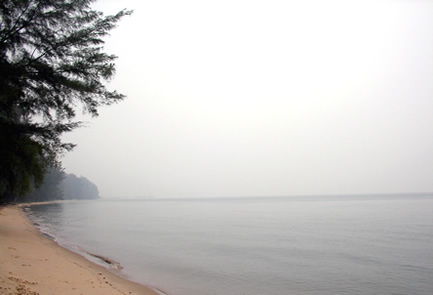
요즘에는 싱가포르의 공기가 나뻐지고 있어요. 왜나하면 불 재가 인도네시아에서 많이 생겼는데 그 재는 바람을 타고 싱가포르로 밀려왔기 때문이에요. The unwelcome haze is back in Singapore. No thanks to the the forest fire in Indonesia and the unfavourable wind direction.

Singapore is a victim of trans-boundary pollution just like Korea. I experienced a sandstorm in Seoul this March. Sandstorm is formed in the desert of Inner Mongolia and will make its way to Korea when the wind direction becomes unfavourable. While I could not actually see those fine sand particles in the air, I knew that a sandstorm had swept pass by just looking at the dirt covering the cars on the road.

I just wish that the north-east monsoon wind can arrive earlier this year and blow the haze back to the Indian Ocean. People used to joke that Singapore has two seasons - a hot summer and a hotter summer. I thought we have four seasons too. 싱가포르에 4계절도 있어요. 더운 여름, 더 더운 여름, 비가 많은 여름하고 멍한 여름. (A hot summer, a hotter summer, a rainy summer and a hazy summer)

To take the gloom out of the hazy days ahead, I thought I shall just add the music video "태양은 가득히" by SM Entertainment's artistes. Let's hope that summer is always filled with sunshine and not haze.


장안이 수원에 있죠

有人说在土上的是西安,土下的是长安。我说长安在水原。长安门卓立在水原华城的最北端。它是华城两道主门之一。另一道主门,八达门,卓立在华城的最南端。我没去过西安,可是我却在水原看到长安 ~ 真有趣。这还是我第一次“体验”到城里城外的生活。


城里看看华城行宫,城外看看老百姓的生活。在长安门外的公园里,看着伯伯们在丹枫树下对弈,这才明白什么叫做国泰民安。


린의 '날 위한 이별'

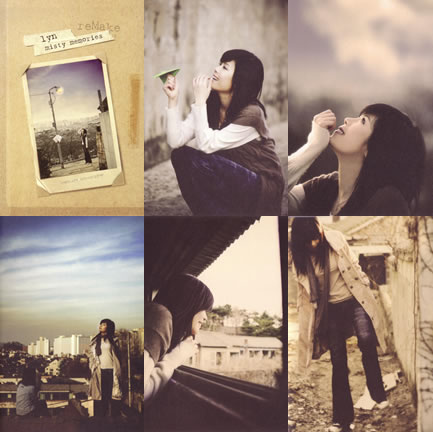
While browsing through the CDs at a shop in Myeongdong subway station , I came across Lyn's "Misty Memories" album. I don't know much about Lyn but I knew that she can sing very well as I was told by a friend. I never regretted buying her album. Her soulful voice accentuates her R&B numbers almost to perfection. I especially like the track '날 위한 이별'.


'날 위한 이별' was made into a music video for the movie '연리지'(連理枝). '연리지' has a sad story behind it and I mean the actual story. In the past, two lovers were stopped from being together. The heart-broken couple ended their lives. A tree grew up from each of their graves. To show their determination to be together after death, the leaves and branches of the two trees wrapped around one another closely. The roots of the trees were also intertwined tightly until they were inseparable. Hence, '연리지' is a noun used to describe a strong desire to be together.

Back to the movie '연리지'. I did not watch it when it was screened in Singapore a few months back. Here I am watching the snippets of the movie for the first time through Lyn's music video '날 위한 이별'. It seems quite a touching movie although the storyline can be a bit of a cliche.

Friday, October 06, 2006

오늘 추석이에요

Today is Mid-Autumn Festival (中秋节) and it is a working day in Singapore. In Korea, it is called Chuseok (추석-秋夕) and they have three days of holiday in a row - one day for the Koreans to make their journey back home; one day to celebrate Chuseok and one day to return to their place of stay. In China, I heard, they have a week of holiday when it comes to 'Zhong Qiu Jie' celebration.


In Singapore, Mid-Autumn Festival is about family reunion, eating of mooncake and pomelo and lantern parade. The festivity mood has been rather low probably because there is no autumn here in the first place and there is no public holiday for festival celebration. However, in the last few years, things are getting slightly better. There are more lantern parades organised. Chinatown was dressed and lighted up for the festival. A lot of creativity was also given to the making and packaging of mooncakes. Besides the standard lotus-bean paste mooncake, there are also novelty mooncakes like chocolate, ice cream and durian mooncakes.

To me, the festival always remind me that while people may be separated by distance on this Earth, we will always be looking upon the same moon.

Thursday, October 05, 2006

얼굴과 몸

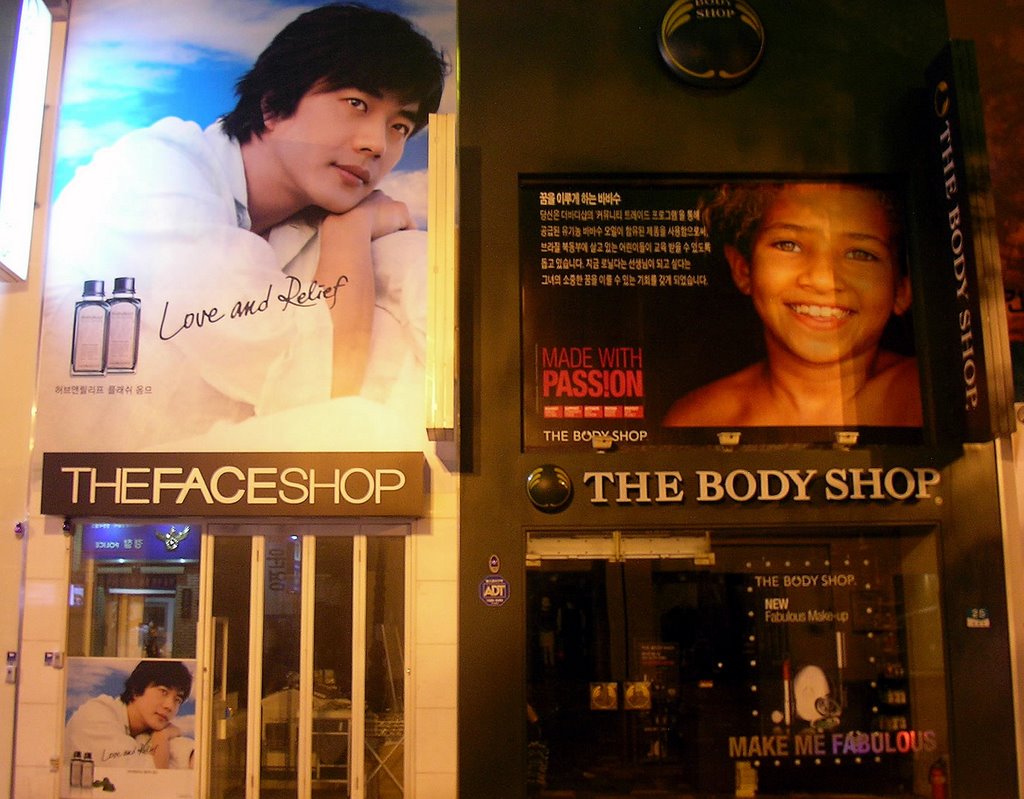
TheFaceShop and The Body Shop, side by side, in Myeongdong

TheFaceShop is a Korean cosmetic retail brand. It has a strong presence in Korea and it currently has 6 retail outlets in Singapore. The rise of TheFaceShop is quite a phenomenon. Barely three years have passed since it entered the market and it already commands over 500 retail outlets worldwide. Its popularity has since grown in Singapore following the visit of Kwon Sang Woo. TheFaceShop can do no wrong especially when The Body Shop is such a successful brand worldwide.

Wednesday, October 04, 2006

학습 환경

I passed by Cheongnyanni(청량리-淸凉里) quite often when I was studying at Kyunghee University. It was in the vicinity of Kyunghee. Cheongnyanni was also the place where I took the airport bus to Incheon airport on the day of departure. However, I must admit that I have problem pronouncing '청량리'. The pronounciation I heard over the public address system in the subway was something like, "이번 역은 청냥니. . ." In my mind, I was wondering why '청냥니' and not '청량리'. I was unable to resolve the conflict between what I saw and heard until I read something in my Korean language textbook.

When the ending consonant of the preceding word is 'ㅇ', the consonant 'ㄹ' in the current word will have to change to 'ㄴ' pronounciation. Hence, it was correct that '청량리' was pronounced '청냥니' and there was nothing wrong with my hearing. Because of Cheongnyanni, I was able to memorise this special deviation and I now pronounce '정리' (arrangement) as '정니' and '등록' (registration) as '등녹'.

The right environment is as important as a good teacher. I remember bargaining with a 아줌마(auntie) in 남대문시장 (Namdaemun Market) in 중국어(Chinese language). The 아줌마 was of course Korean but her Chinese was perfect. There was no way I could gain an upperhand in the bargain although I was very comfortable speaking in Chinese. The market, it seems, is a good environment for language learning. I bet that the 아줌마 did not enrol herself to learn Chinese. She must have practised her Chinese with the many Chinese tourists who patronised her shop over the years. I am also not surprised if she can also speak Japanese or Russian well.

The 아저씨(uncle) whom I met in the PC방(Internet Kiosk) also spoke good Chinese. I might have mistaken myself to be in China. The 아저씨 was no immigrant from China although I thought he was. He told me that he picked up the language because it was taught during his school days and he had the opportunity to practise it with the many Chinese students who visited his PC방.

Sometimes I just wonder, maybe I should stop paying to learn Korean. I might as well set up a shop selling Korean grocery and products in Singapore. I can then practise my Korean language with those Korean 아줌마 who patronise my shop. Isn't it wonderful that I can earn and learn at the same time?

Tuesday, October 03, 2006

저녁을 드셨어요?


Roadside stalls at Insadong

Roadside stalls 볼 때마다 맛있는 음식을 생각나요. The mental linkage of roadside stall to delicious food has a lot to do with my past experience of eating at the roadside stall. I remember when I was a kid, I love to eat the 'wanton mee' (만두 면) sold at this roadside stall. The stall was actually operating illegally at night. Nevertheless, people were queuing up for its 'wanton mee'. That was the best 'wanton mee' I have ever eaten. It was a pity that such good food was not allowed to be sold over a roadside stall.

Roadside stalls were banned in Singapore because of concern for public health. In the past, contaminated food was the main culprit in spreading diseases like Cholera and Dysentery that claimed many lives. To better regulate the standard of hygience in food preparation, all roadside hawkers were shifted to hawker centres to continue their fares. Hawker centres have since become something very unique in the Singapore food culture map.

Singapore may have ranked among the best in the world for public health but one of the casualty it claims along the way is the roadside stall which is a common sight in many countries that enjoy vibrant roadside food culture. Whatever it may be, if I do sit at a roadside stall overseas, it will probably remind me of my childhood day in Singapore.

Monday, October 02, 2006

커피 마셔요?

Personally I do not take to the coffee-drinking lifestyle very much. The cafes in Singapore are small and usually crowded with people. If only if the cafes here are as big and well designed as those in Seoul, I may consider changing my lifestyle. When I say big, the cafes in Seoul can be as high as four-storey and occupy one whole block of building. It is quite surprising that a western lifestyle can make it big time in Korea and not in Singapore. I guess maybe our local kopitiams (coffee shops) have been doing a fine job of brewing fresh and fragrant coffee every day at one-fifth of the price of coffee sold at the cafe chains. In Singapore, sitting in a cafe drinking coffee is a lifestyle but sitting in a kopitiam drinking coffee is a way of life.

Starbucks Coffee in Myeondong (Top Left). Coffee Bean in Insadong (Top Right). Inside Coffee Bean in Hurest Wellbeing Club, Myeongdong (Bottom)